
Understanding the Primary Residence Exclusion: Current Rules for Children
For many California families, the family home is the "anchor" of their history. It is where children were raised, holidays were celebrated, and a lifetime of hard work was realized in the form of equity. Passing that home to the next generation is often a parent's most heartfelt goal—a way to provide their children with a head start or a sense of permanent belonging. However, in the current legal landscape, the emotional desire to "keep it in the family" now carries significant financial and administrative weight.
The Shift from Simplicity to Strategy
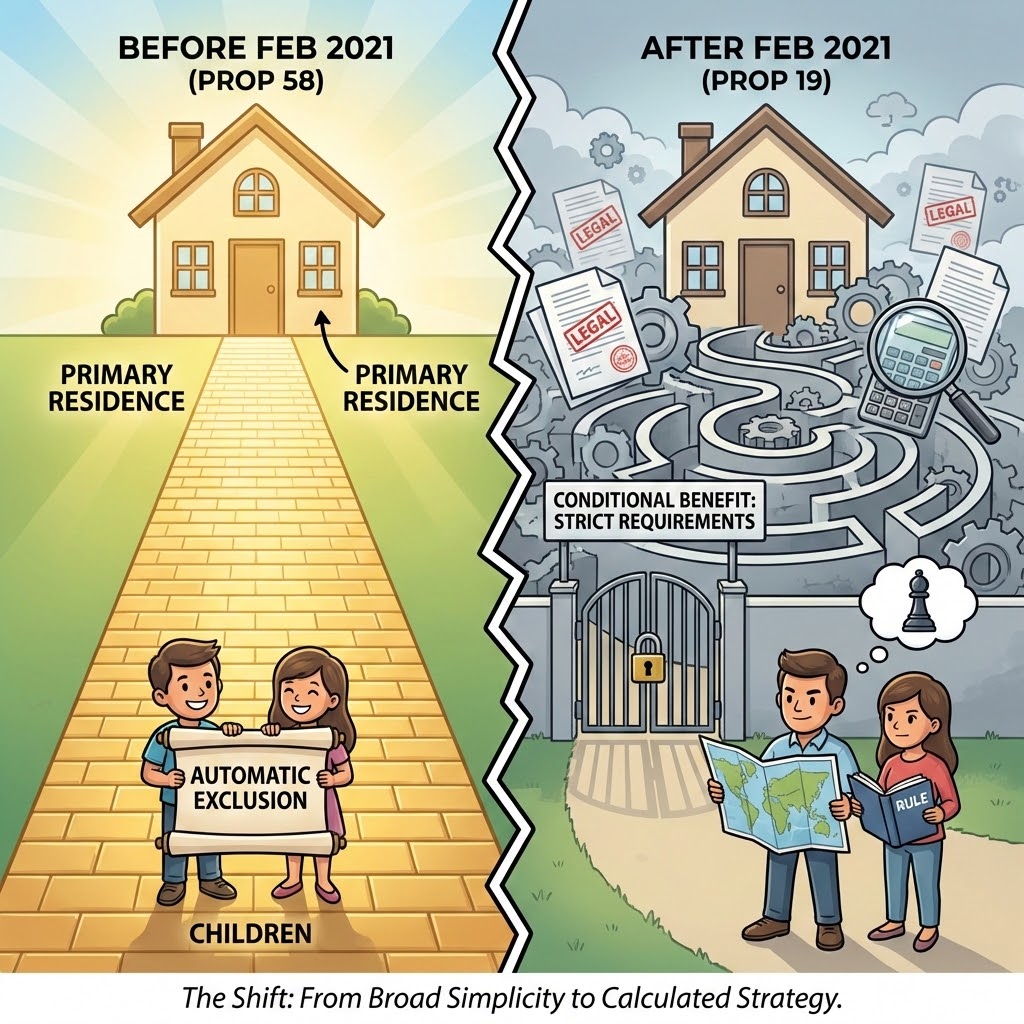
To understand the current rules, we must look at how the landscape has narrowed. For decades, under Proposition 58, the "Parent-to-Child Exclusion" was a broad and reliable tool. Parents could transfer their primary residence to their children with a near-certainty that the child would inherit the parent’s low Proposition 13 tax base, regardless of the home’s market value or how the child intended to use the property.
That era of simplicity ended with the implementation of Proposition 19 in February 2021. The law fundamentally redefined what it means to inherit a "primary residence." Today, the exclusion is no longer an automatic right; it is a conditional benefit that requires strict adherence to residency requirements and value limitations.
The Technical Breakdown: The Three Pillars of Eligibility
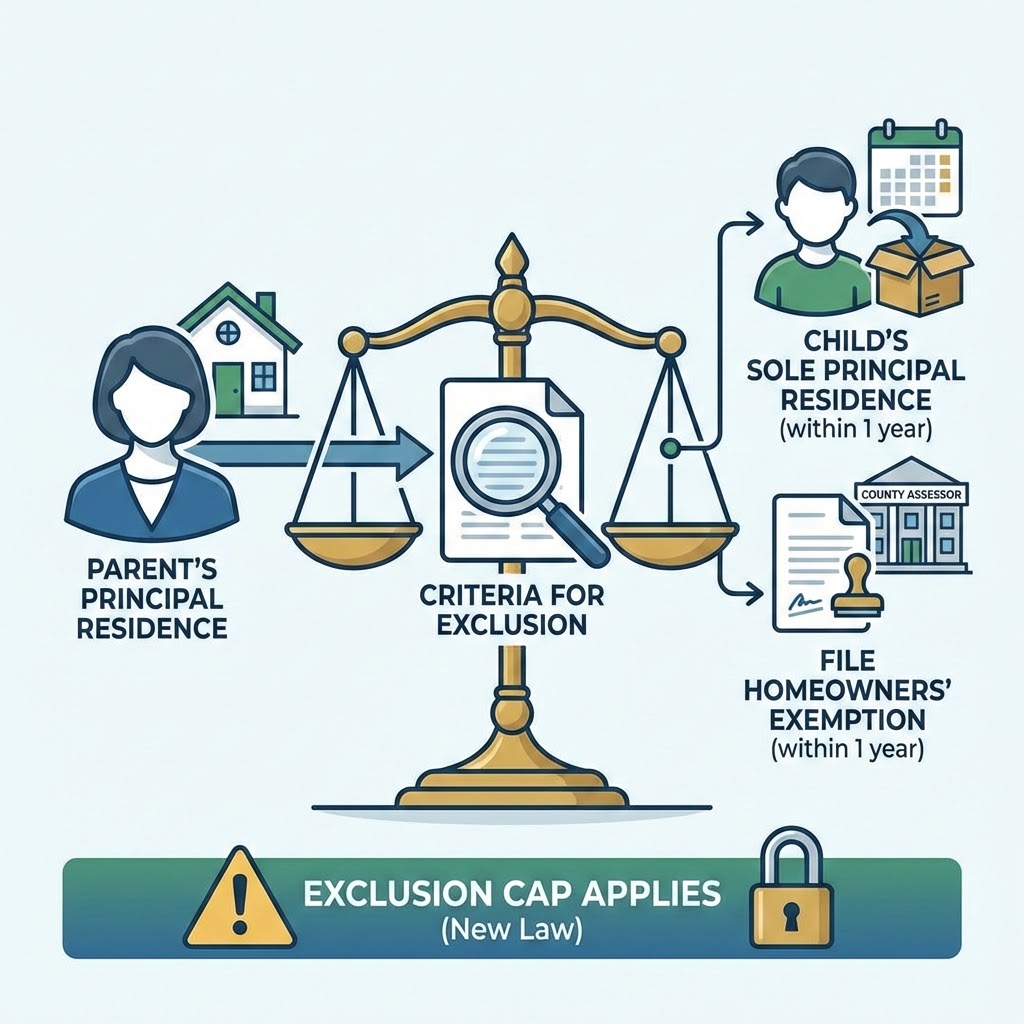
If you are planning to transfer a home to your children—or if you are a child preparing to inherit one—the law now looks for three specific criteria to maintain a tax exclusion:
The Status of the Parent: At the time of the transfer, the property must be the principal residence of the parent (the transferor).
The Residency of the Child: The child (the transferee) must move into the home and establish it as their sole principal residence within one year of the date of transfer.
The Proper Documentation: The child must file for the Homeowners’ Exemption (or Disabled Veterans’ Exemption) with the County Assessor within that same one-year window to prove residency.
If these criteria are met, the child may qualify for an exclusion. However, unlike the old law, the exclusion is now capped.
The Value Test: Navigating the 2026 Threshold
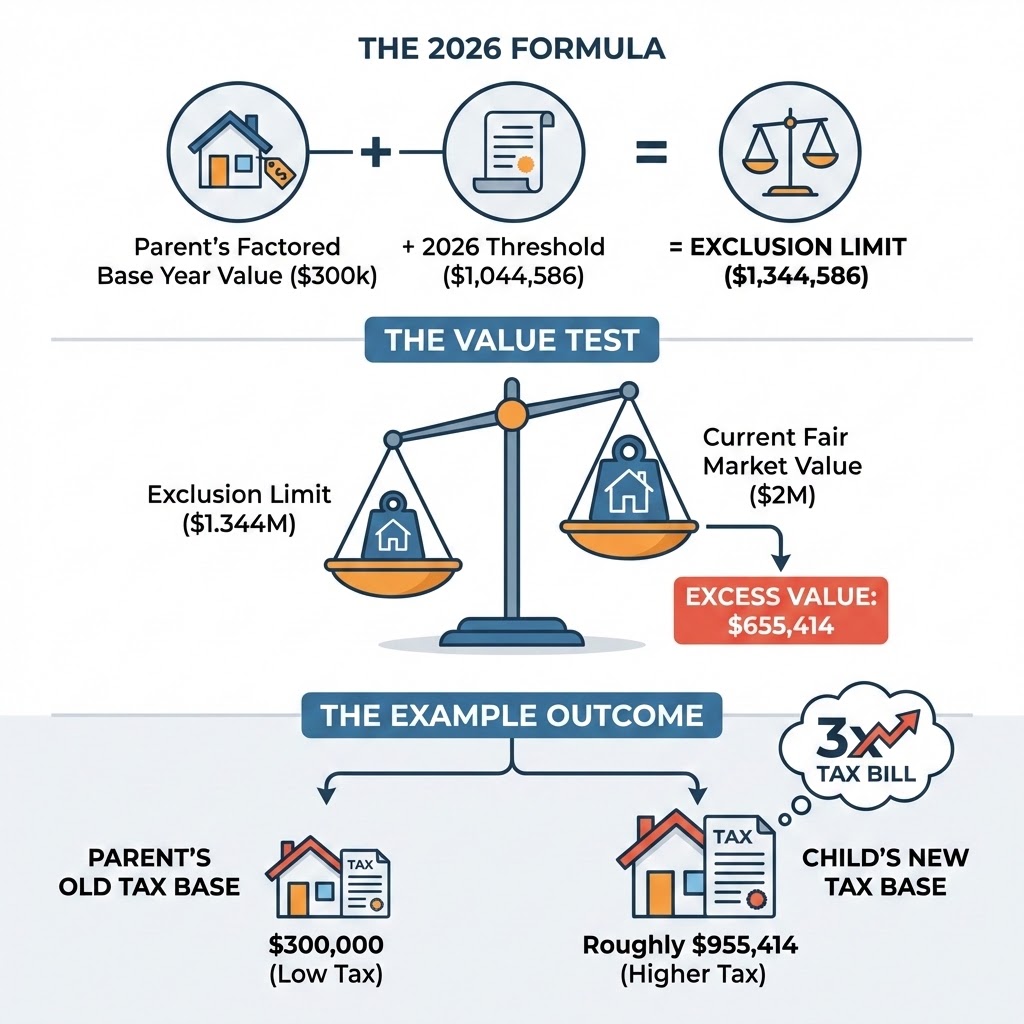
Perhaps the most complex part of the current law is the "Value Cap." As of 2026, the inflation-adjusted exclusion threshold is $1,044,586. To determine if a home will be partially reassessed, the state uses a specific formula:
The Formula: (Parent’s Factored Base Year Value) + ($1,044,586) = The Exclusion Limit.
If the fair market value of the home at the time of transfer is less than this limit, the child keeps the parent's old tax base entirely. If the market value is more than this limit, the "excess value" is added to the parent's old base.
Example: Imagine a family home with a parent’s tax base of $300,000, but a current market value of $2,000,000. Under the current 2026 rules, the Exclusion Limit is $1,344,586 ($300k + $1.044M). Because the market value ($2M) exceeds that limit by $655,414, that "excess" is added back to the base. The child’s new tax base would be roughly $955,414. While this is better than a full $2 million reassessment, it still represents a tripling of the annual tax bill.
Why It Matters: Protecting the Next Generation’s Budget
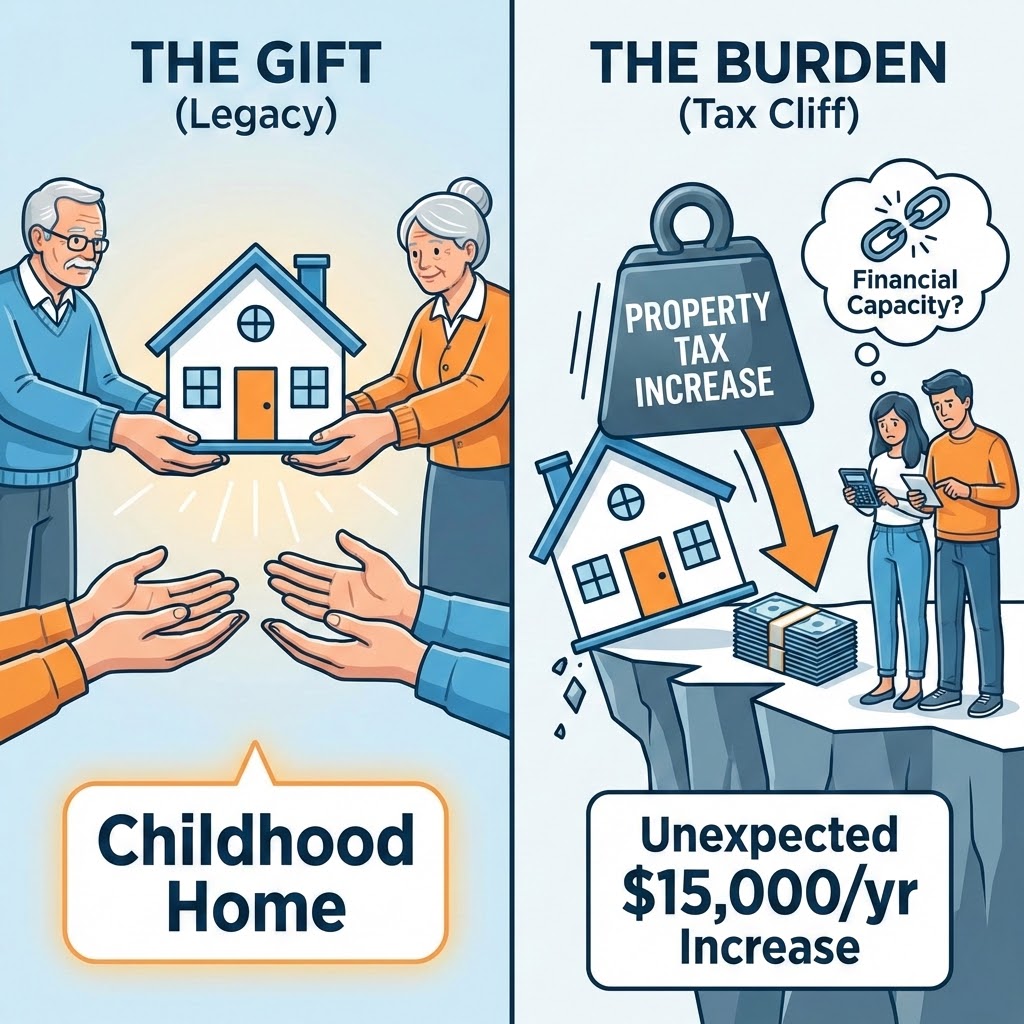
For families in the 45–65 age range, this "Tax Cliff" is a primary concern. Many parents worry that by leaving the house to their children, they are inadvertently leaving them a "tax bill they can't afford." For a young professional or a growing family in their 30s, an unexpected $15,000-per-year increase in property taxes can be the difference between keeping their childhood home and being forced to sell it.
Legacy preservation is no longer just about who gets the keys; it is about ensuring the recipient has the financial capacity to turn the key. Without proper planning, the "gift" of a home can quickly become a financial burden that disrupts a child's long-term budgeting and retirement goals.
The 2026 Landscape: A Sense of Urgency
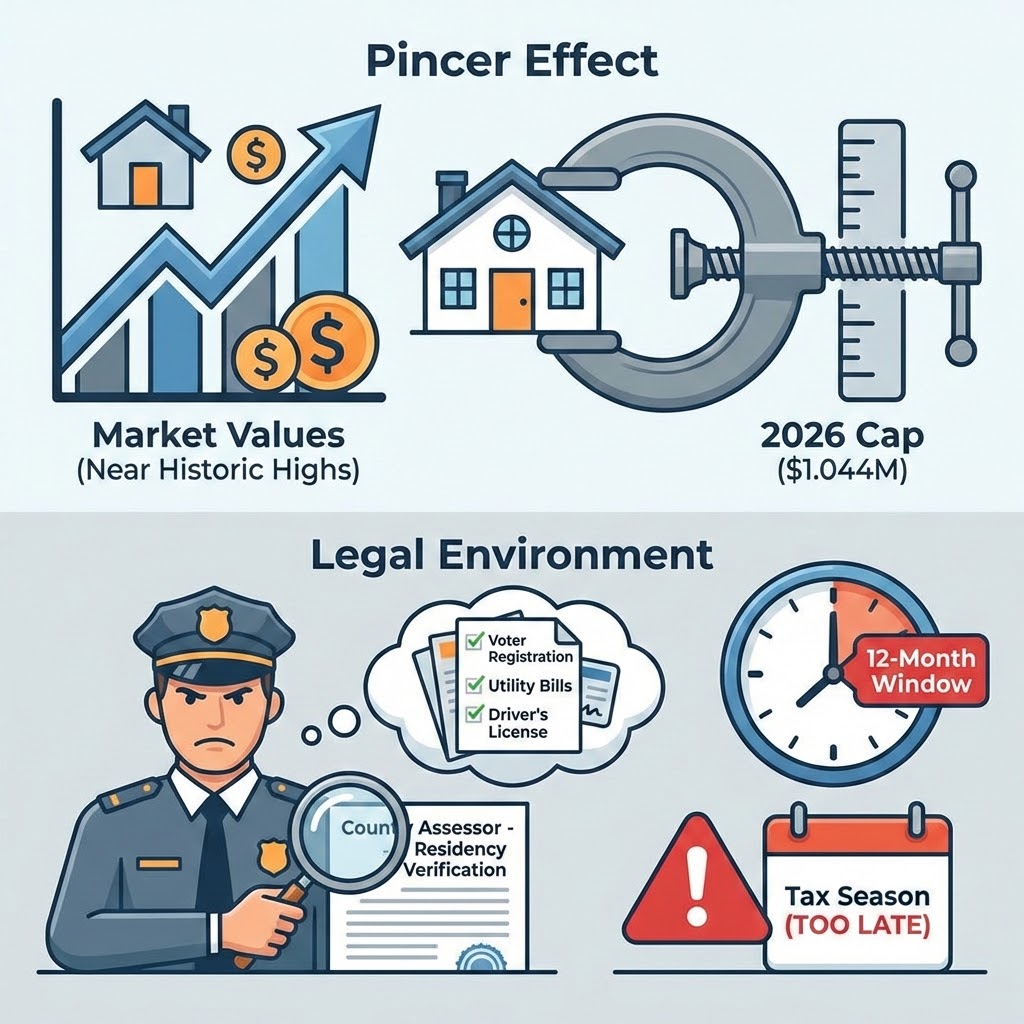
As we move through 2026, California real estate values in many regions remain near historic highs. This creates a "pincer effect" for families: as market values rise, the $1.044 million cap—while adjusted for inflation—covers a smaller percentage of a home's total value.
Furthermore, the legal environment is increasingly rigorous. County assessors are more diligent than ever in verifying residency. In 2026, "intent" to move in is not enough; the child must provide concrete proof of residency, such as voter registration, utility bills, and driver’s license updates, all within that strict twelve-month window. Waiting until "tax season" to look at these requirements is often too late.

The Risk Mitigation Narrative: The CBM Approach
At CBM Estate & Trust Law, we view our role as your guide through this narrow passage. Our focus is not on finding "loopholes"—which often create more risk than they solve—but on thoughtful, proactive planning. Effective planning often involves more than just a deed. It may involve:
Customized Trust Provisions: Updating your Revocable Living Trust to allow for "non-pro-rata" distributions. This can allow one child (who intends to live in the home) to receive the house, while other children receive cash or other assets of equal value, keeping the tax exclusion intact.
Property Tax Risk Reviews: We perform the math for you, projecting exactly what the "post-transfer" tax bill will look like so your family can make informed decisions.
Governance Agreements: For families where multiple siblings may eventually share the home, we help draft agreements that define who pays the taxes and what happens if the resident sibling moves out.

Important Considerations & Compliance
California property tax rules are exceptionally complex and are subject to varying interpretations by individual county assessors. It is important to acknowledge that while proper legal structuring can significantly reduce the risk of a full reassessment, no strategy can guarantee a specific outcome from the state. The rules regarding Proposition 19 continue to be clarified by the State Board of Equalization, and what was true two years ago may have evolved today. Our goal is to provide you with the most current, compliant framework to support your family's long-term objectives.

Schedule a Consultation
The Primary Residence Exclusion is one of the most valuable—and most fragile—benefits available to California homeowners. If you are considering passing your home to your children, or if you have recently inherited property and are unsure of the next steps, we are here to help.
Contact CBM Estate & Trust Law today to schedule a consultation. Our attorneys can help you review your property’s history and develop a customized planning strategy to protect your family’s future.
