
Understanding the Impact of Proposition 19 on Family Transfers
For decades, California real estate has been more than just an asset; it has been a cornerstone of family legacy. Under the long-standing protections of Proposition 13 and later Proposition 58, families could pass property from one generation to the next with a degree of tax certainty that was the envy of many other states. However, the legal landscape shifted dramatically with the implementation of Proposition 19.
As we navigate the complexities of 2026, many California families are finding that the "automatic" protections they once counted on have been replaced by a narrow, high-stakes set of requirements. Understanding these changes is no longer just a matter of curiosity—it is a financial necessity for anyone intending to keep real estate within their family for the long term.
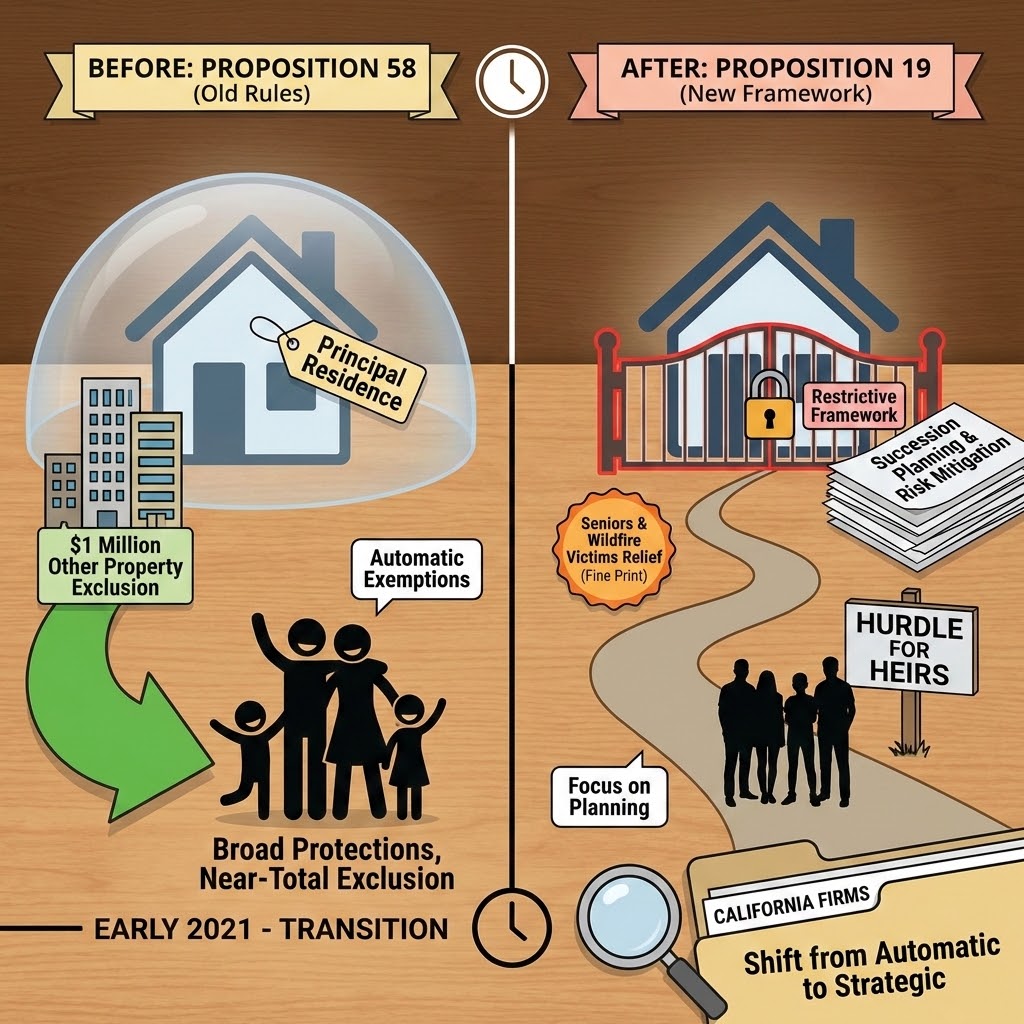
The Transition from Proposition 58 to Proposition 19
To understand where we are today, we must look at where we were. Under the old rules (Proposition 58), parents could transfer their principal residence to their children with a near-total exclusion from reassessment, regardless of the home's market value. Additionally, they could transfer up to $1 million of "other property" (assessed value)—such as rental units or vacation homes—without triggering a tax hike.
Proposition 19, which became fully operative for family transfers in early 2021, effectively dismantled those broad protections. In its place, it established a much more restrictive framework. The law was presented as a way to help seniors and wildfire victims move their tax bases, but the "fine print" regarding intergenerational transfers has created a significant hurdle for heirs. Today, the focus for California firms is no longer on "automatic exemptions" but on succession planning and risk mitigation.
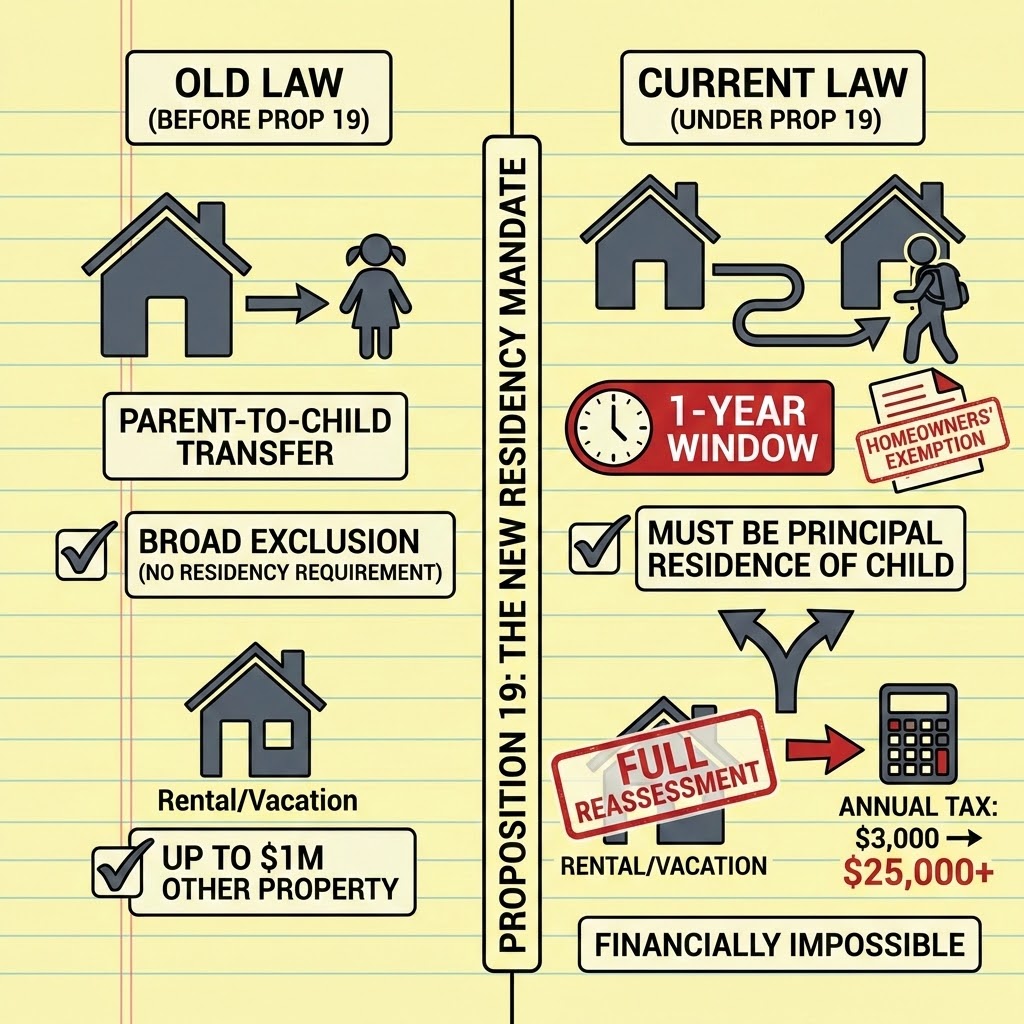
The New Residency Mandate: More Than Just a Formality
The most fundamental change under Proposition 19 is the principal residence requirement. Under the current law, for a parent-to-child transfer to qualify for any exclusion from reassessment, the property must have been the principal residence of the parent and it must become the principal residence of the child.
This requirement introduces a strict one-year window. The child must move into the property and file for a Homeowners’ Exemption (or Disabled Veterans’ Exemption) within one year of the date of transfer. If the child intends to keep the house as a rental property, a secondary residence, or a vacation home, the law mandates a full reassessment to current market value. For a home purchased in the 1970s or 80s, this can result in an annual property tax bill jumping from $3,000 to $25,000 or more overnight, often making it financially impossible for the child to keep the home.
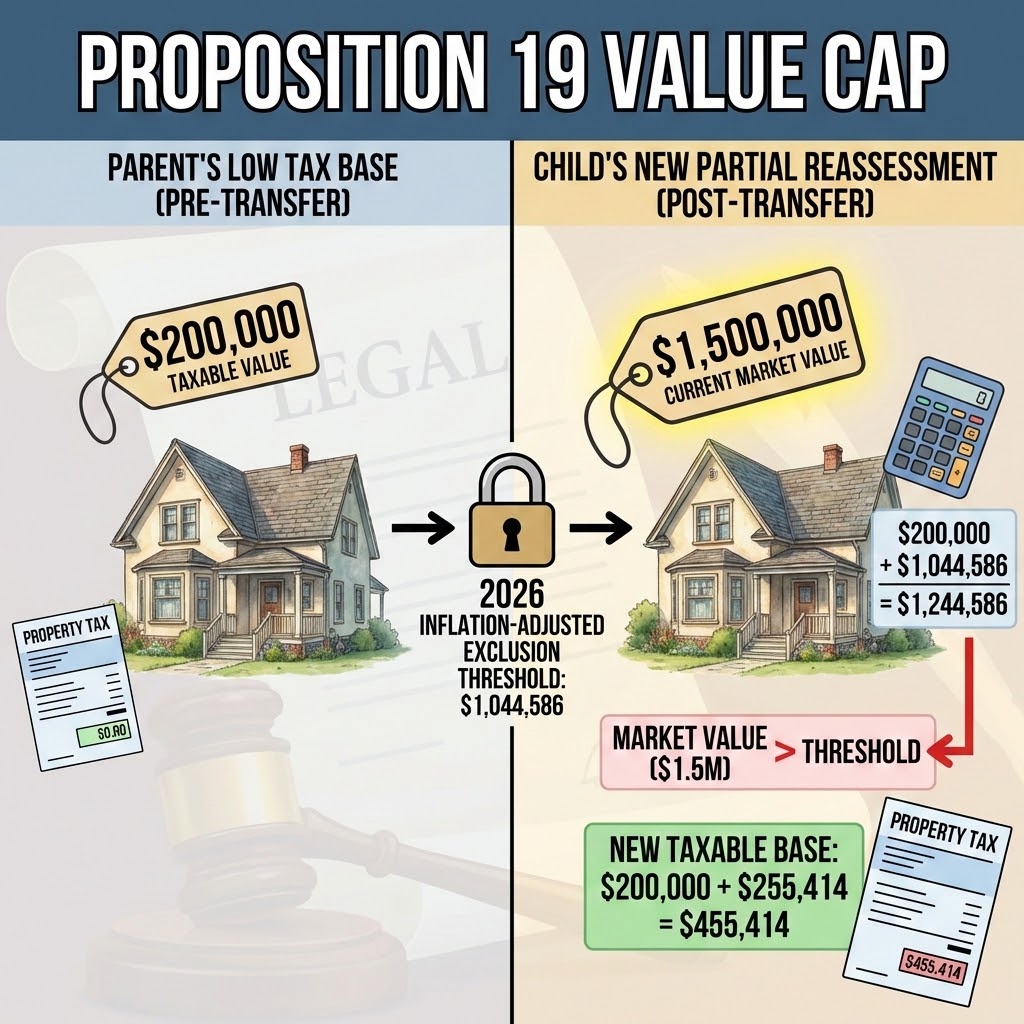
Understanding the Value Cap: The 2026 Threshold
Even if the child meets the residency requirement, the exclusion is no longer unlimited. Proposition 19 introduced a "Value Cap" formula that limits how much of the parent’s low tax base can be preserved.
As of 2026, the inflation-adjusted exclusion threshold is $1,044,586. To determine if a property will be partially reassessed, the county assessor looks at whether the property’s current market value exceeds the "taxable value" (the parent’s old base) plus this $1,044,586 cushion.
Calculation Example: If a parent’s home has a taxable value of $200,000 and a current market value of $1.5 million, the formula would be: $200,000 + $1,044,586 = $1,244,586. Since the market value ($1.5M) is higher than this threshold, the difference of $255,414 is added to the parent’s old $200,000 base. The child’s new taxable base becomes $455,414.
While this is better than a full reassessment to $1.5 million, it still represents a significant tax increase. For homes in high-value coastal areas where market values often exceed the $2 million or $3 million mark, the partial reassessment can be substantial.
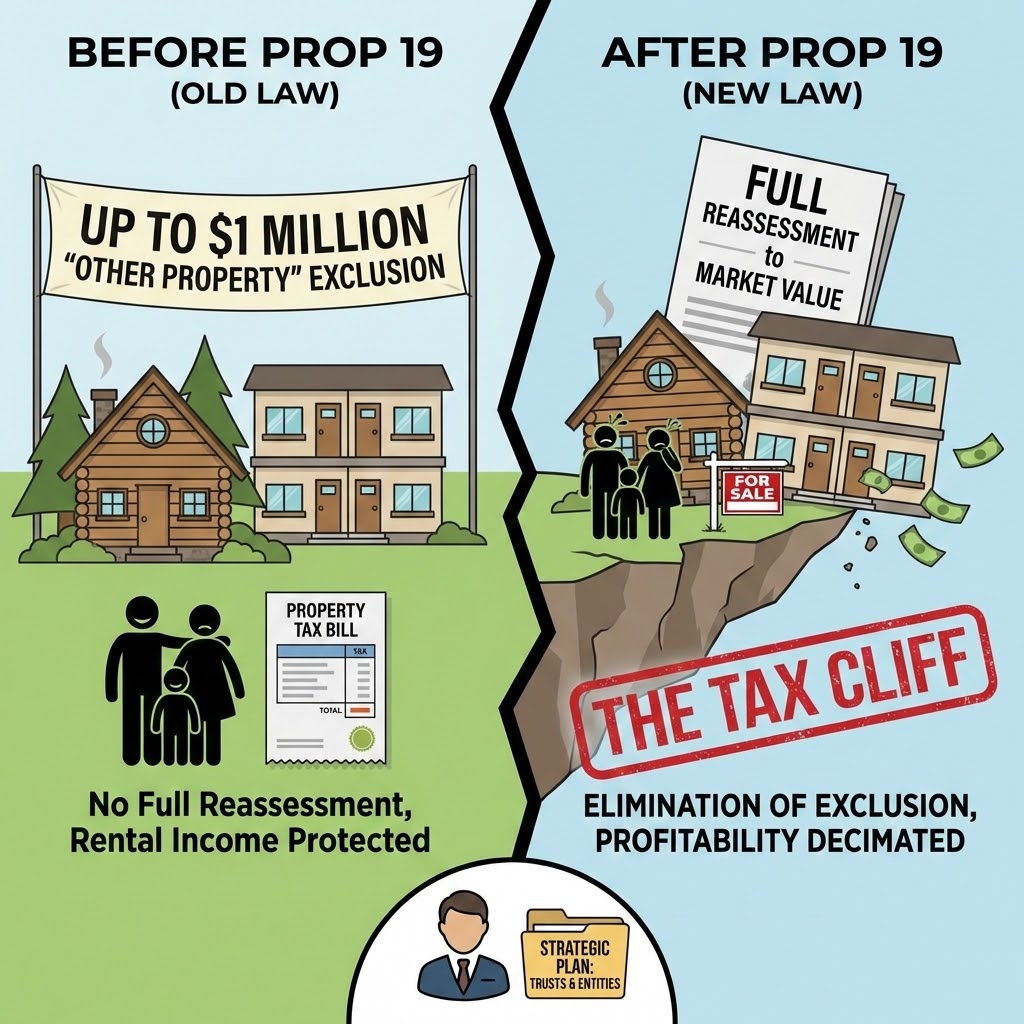
The Impact on Investment and Vacation Properties
One of the most difficult adjustments for families has been the total elimination of the "Other Property" exclusion. Under Proposition 19, there is no longer a $1 million (assessed value) allowance for non-principal residences.
This means that any transfer of a family cabin, a rental duplex, or a small commercial building between parents and children will trigger a full reassessment to fair market value upon transfer. For families who rely on rental income from inherited properties to support their lifestyle or retirement, this "tax cliff" can decimate the property’s profitability. Without a strategic plan involving entity formation or specific trust structures, many heirs are forced to sell these properties simply to pay the new tax obligations.

The Challenge for Multiple Heirs
When multiple siblings inherit a family home, Proposition 19 adds a layer of logistical complexity. Fortunately, the State Board of Equalization has clarified that not all siblings must move into the home to maintain the exclusion. As long as at least one sibling uses the home as their principal residence and files the appropriate exemptions, the parent-to-child exclusion can remain in place.
However, issues arise if that "resident sibling" eventually moves out. At that point, the property will generally be reassessed to its market value as of the date of the original inheritance (plus inflation adjustments), unless another eligible sibling moves in within a year. This creates a "linked" financial situation between siblings that requires clear, written agreements—often in the form of a Trust or Operating Agreement—to manage expectations and costs.

Proactive Planning: Beyond the Simple Deed Transfer
Given these strict rules, the days of simply "signing a deed over to the kids" are over. Modern real estate succession planning requires a multi-faceted approach:
Property Tax Risk Review: Before any transfer occurs, a professional analysis of the current tax base and projected market value is essential to quantify the potential tax exposure.
Entity Integration: In some cases, holding property within a family-owned entity (like an LLC) may offer management advantages, though it is important to note that transferring interests in an entity carries its own set of complex "Change in Control" rules.
Trust Customization: Standard revocable living trusts often do not have the specific "Prop 19" language needed to handle non-pro-rata distributions. This allows for allocating the family home to the sibling most likely to live in it, while balancing the inheritance with other assets for the remaining heirs.
The goal is to align your real estate holdings with your broader estate planning objectives, ensuring that the tax burden does not outweigh the benefit of the inheritance.

Filing and Compliance: Avoiding Administrative Pitfalls
Finally, even a well-structured plan can fail if the paperwork is not handled with precision. Filing a Claim for Reassessment Exclusion for Transfer Between Parent and Child is a mandatory step. While you generally have three years from the date of transfer to file, failing to do so before the property is sold to a third party or within the prescribed timelines can result in lost benefits or the need for a costly appeal process.
Furthermore, the interplay between the Preliminary Change of Ownership Report (PCOR) and the Homeowners' Exemption is critical. Missing a filing deadline by even a few weeks can trigger a supplemental tax bill that is difficult to reverse.

Preserving the Family Legacy with Professional Guidance
California’s property tax rules are among the most complex in the nation, and Proposition 19 has made them even more so. At CBM Estate & Trust Law, we believe that transparency and preparation are the best tools for peace of mind. Our approach is not about promising "loopholes," but about helping families make informed, compliant decisions that protect their assets for the next generation.
If you own California real estate and are concerned about how these rules will affect your heirs, now is the time to evaluate your options. We can help you navigate the math of the 2026 value caps, the residency requirements, and the long-term governance of your family properties.
Contact CBM Estate & Trust Law today to schedule a consultation. Our attorneys can help you review your property’s history and develop a customized planning strategy to protect your family’s future.
