
The Legacy of the Family Home: More Than Just a Number
For most families, a home isn’t just an entry on a balance sheet; it is the physical vessel for decades of memories, the backdrop of childhoods, and the cornerstone of a hard-earned legacy. However, when it comes to the financial and legal "value" of that home, many homeowners feel a sense of dread. The confusion often stems from a simple question: why does the real estate appraiser say my home is worth millions, while the tax bill says something entirely different?
Understanding the distinction between these values is the first step in protecting what you’ve built.

The Evolution of Value: How We Got Here
The disconnect between "what it’s worth" and "what you pay taxes on" isn't an accident—it's a product of decades of shifting legislation. For nearly 50 years, homeowners have navigated a landscape shaped by landmark laws like Proposition 13, which sought to provide stability in an unpredictable market. Over time, these rules have been refined and narrowed by further measures like Proposition 19. These laws were created to ensure that a sudden spike in neighborhood popularity wouldn't price a long-term resident out of their own living room, creating two distinct "realities" for every property.
Decoding the Terms: The Technical Breakdown
To navigate your property’s finances, you need to understand these two competing figures:
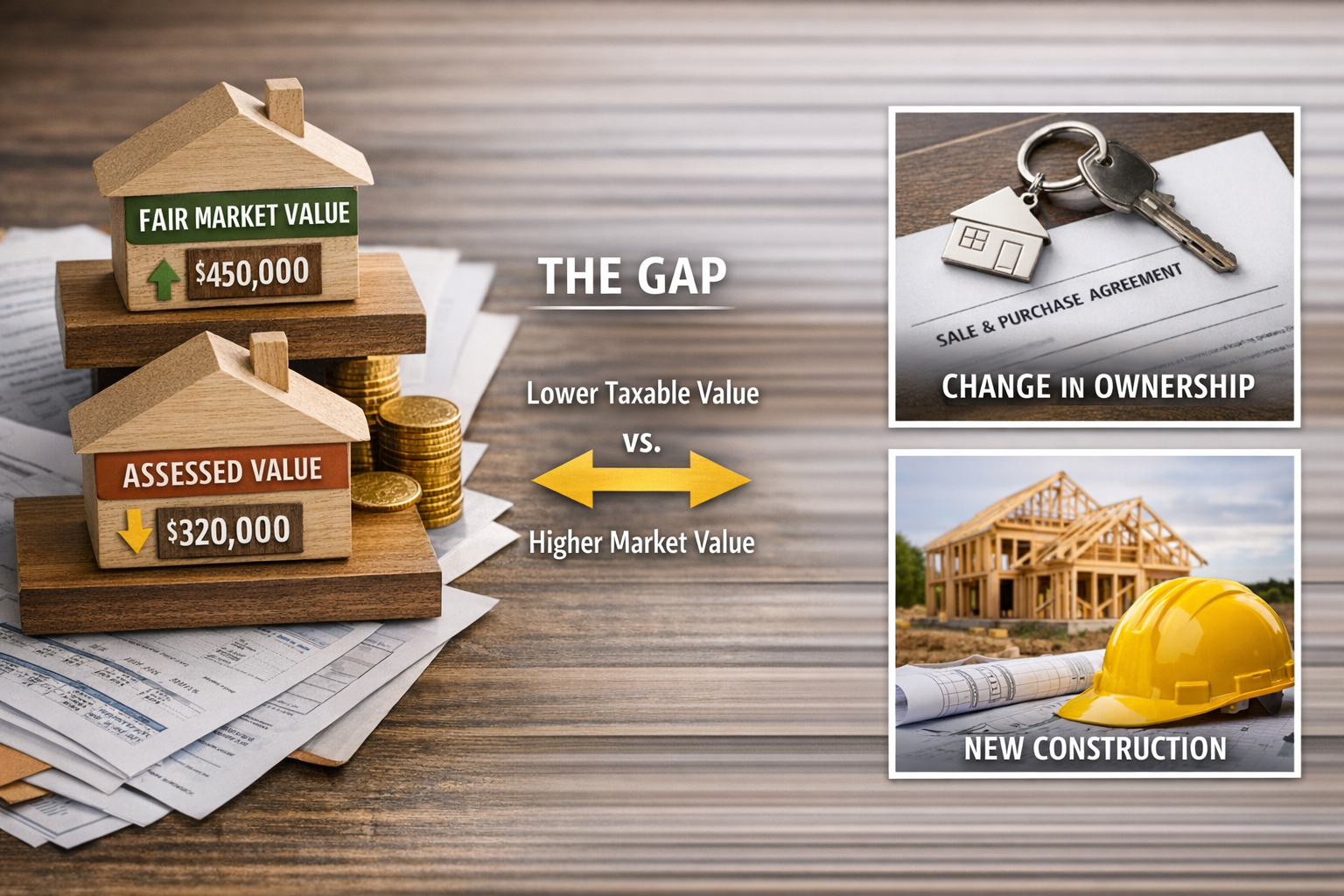
Fair Market Value (FMV): This is the "hypothetical price." It represents what a willing buyer would pay a willing seller on the open market today. It fluctuates with interest rates, school rankings, and local demand.
Assessed Value: This is the "taxable price." It is the value used by the County Assessor to calculate your annual property tax.
The Gap: In a healthy market, your Assessed Value is often significantly lower than your Fair Market Value due to annual caps on assessment increases (typically 2% per year).
The Trigger: A property is generally only reassessed to full Fair Market Value upon a "change in ownership" or completion of new construction.

Why It Matters: Protecting Your Fixed Income and Future
For the 20–65 demographic, this distinction is critical for two reasons: Budgeting and Legacy.
If you are a mid-career professional helping aging parents, or if you are approaching retirement yourself, a fixed income relies on the stability of the Assessed Value. A sudden "reassessment" to current Fair Market Value can double or triple a tax bill overnight, turning a comfortable retirement into a financial crisis. Furthermore, when planning to pass a home to the next generation, understanding how these values interact determines whether your children can afford to keep the family home or will be forced to sell it just to pay the tax man.

The 2026 Landscape: A Sense of Urgency
As we move through 2026, the legal environment regarding property transfers has become more stringent than in years past. With the full implementation of recent tax updates, the "automatic" carryover of a low Assessed Value to heirs is no longer a guarantee for many types of property. Relying on "how things used to be" is a high-risk strategy. The gap between your home’s current market worth and its tax-base value has likely never been wider, making the stakes for proper planning higher than ever.

Navigating the Risks with a Guide
You don't have to guess where you stand. Our role is to act as your guide through this maze of valuations. Rather than looking for "loopholes" that may not hold up under scrutiny, we focus on proactive planning. By analyzing the current Fair Market Value against your existing Assessed Value, we can help you model future scenarios—whether that involves a sale, a renovation, or an inheritance—to ensure there are no expensive surprises waiting for your family.

The Compliance Guardrail
It is important to acknowledge that property tax law is exceptionally complex and subject to the specific interpretations of the County Assessor’s office. Factors such as primary residency requirements, the specific timing of transfers, and even the type of deed used can change the outcome. All property owners should recognize that while we provide strategic planning, the final determination of value always rests with the official governing bodies.

Secure Your Family’s Financial Footing
Understanding the value of your home is the foundation of a sound financial plan. If you have questions about how the gap between Market and Assessed value impacts your long-term goals, we invite you to start a conversation.
Contact CBM Estate & Trust Law today to schedule a consultation. Our attorneys can help you review your property’s history and develop a customized planning strategy to protect your family’s future.
