
Navigating the $1M Over-Market Threshold
A California home is almost never just a line item on a balance sheet.
For many families, it is the one asset that carries the full weight of sacrifice: the first mortgage payment, the overtime years, the remodel done one room at a time, the promise that something stable would be left behind. That is why conversations about Proposition 19 should never begin with statutes alone. They should begin with what is actually at stake: keeping a family’s footing intact when property moves from one generation to the next.
That emotional weight matters even more in California because Proposition 13 changed the property tax system in 1978 by limiting the general tax rate to 1 percent plus voter-approved debt and capping annual assessment growth at no more than 2 percent unless there is a reassessment event. In practical terms, that is why longtime owners often carry tax bases far below present-day market value.

How We Got Here
For years, many families planned around the old parent-child exclusion rules under Propositions 58 and 193. Under that older framework, a principal residence could generally transfer without a value cap, and certain “other real property” could also qualify up to a $1 million factored base year value limit. Proposition 19 narrowed that landscape for transfers occurring on or after February 16, 2021. Under current law, the broad exclusion for “other real property” is gone, and the focus is now on qualifying family homes and family farms.
That shift is why so many families feel surprised. They are often operating with an old mental model: “We can just transfer the house to the kids and keep the tax base.” In 2026, that assumption is no longer safe without checking the numbers, the occupancy requirements, and the fair market value on the date of transfer.
What the Threshold Really Means in Plain English
Many people casually call this the “$1 million threshold,” but that shorthand can be misleading.
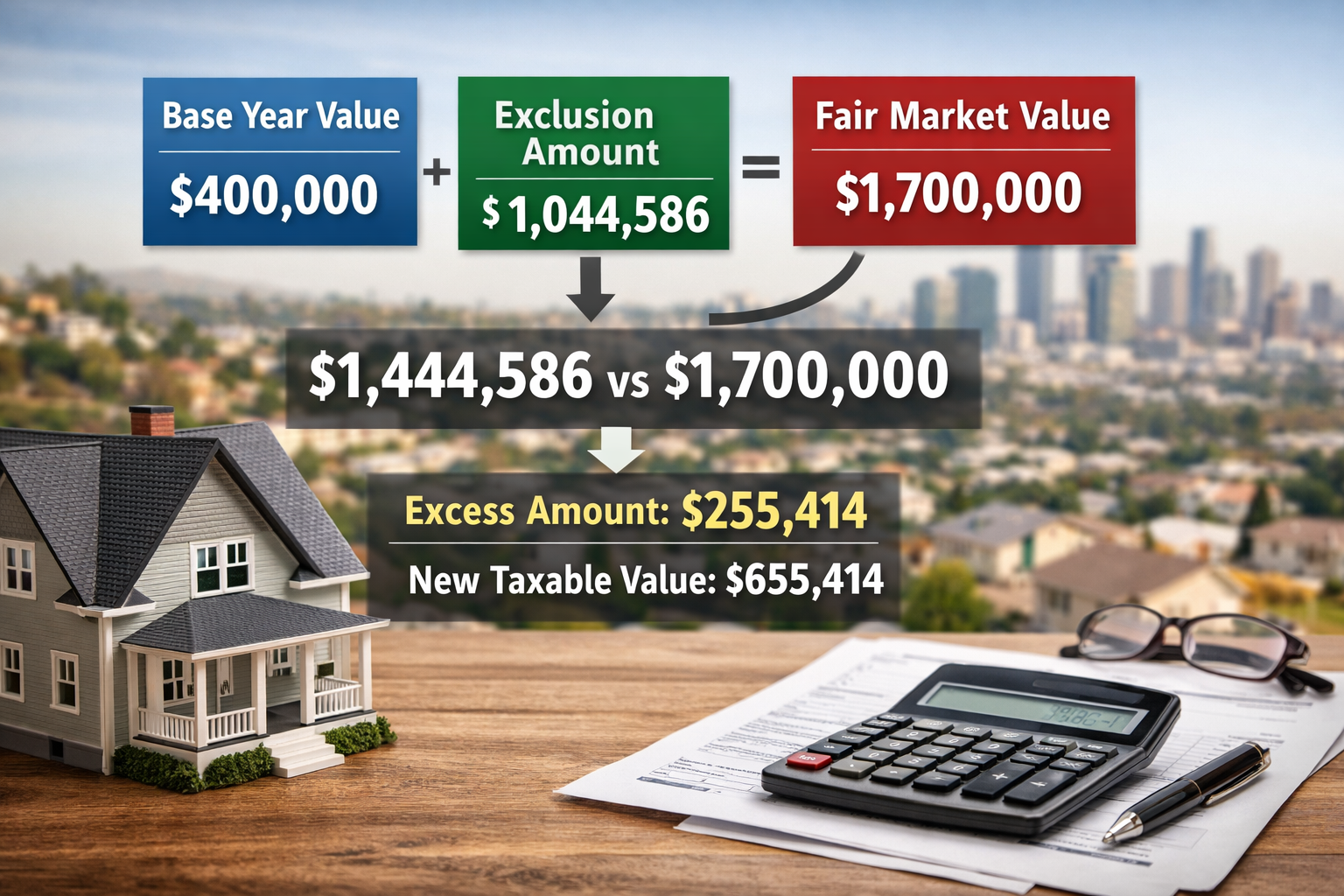
Under Proposition 19, the real test is whether the property’s fair market value on the transfer date is more than the property’s factored base year value plus the inflation-adjusted exclusion amount. For transfers from February 16, 2025 through February 15, 2027, that adjusted exclusion amount is $1,044,586. If the fair market value is at or below that total, the taxable value can generally carry over. If the fair market value is higher, the amount above that limit is added to the old taxable value.
Here is the simple version:
Start with the home’s factored base year value.
Add $1,044,586 for transfers in the current February 16, 2025 to February 15, 2027 adjustment period.
Compare that number to the home’s fair market value on the transfer date.
If the fair market value is below or equal to that combined number, there may be no added taxable value.
If the fair market value is higher, the excess is added to the existing taxable value.
A quick example makes this easier to see.
If a parent’s home has a factored base year value of $400,000, the current Proposition 19 comparison number would be $1,444,586. If the fair market value on the transfer date is $1,700,000, the excess is $255,414. That excess is then added to the original taxable value, producing a new taxable value of $655,414. That does not erase the exclusion entirely, but it does mean the next generation may inherit a much higher tax bill than expected. The rule itself comes directly from BOE guidance; the numbers here simply apply the current 2025–2027 adjusted amount to that formula.

Why This Matters to Real Families
For someone in their 20s or 30s, this issue is often about affordability. They may be inheriting a home in a market they could never buy into at today’s prices, and a property tax jump can affect whether keeping that home is realistic.
For people in their 40s and 50s, the concern is often more layered. They may be supporting children, helping aging parents, and trying to preserve a family asset without triggering a cost structure that strains monthly cash flow.
For those in their 60s and beyond, the question becomes even more personal: Will the home stay in the family, or will taxes quietly force a sale later? That is why the over-threshold calculation matters. It is not just technical. It affects planning, timing, and whether “legacy” is actually sustainable.

The Modern 2026 Pivot
As of April 7, 2026, the operative legal reality is narrower and more precise than many families realize. The current adjustment period still uses the $1,044,586 figure, and the old exclusion for other transferred real property remains unavailable for post-February 15, 2021 transfers. In other words, this is not the era of broad informal assumptions. It is the era of exact numbers, exact facts, and exact filing.
For family homes, there is another key point: the transferred property must have been the transferor’s principal residence, and the transferee generally must make it their own primary residence within one year and file for the homeowners’ or disabled veterans’ exemption within one year to receive relief as of the transfer date. For family farms, the law is more flexible because there is no requirement that the farm contain a home occupied by the transferee.

Where Families Usually Get Into Trouble
The biggest mistakes usually do not come from bad intentions. They come from bad assumptions.
A family may assume the phrase “under a million” is the real test, when the actual comparison is fair market value versus taxable value plus the inflation-adjusted exclusion amount.
Another family may assume the assessor will “work it out later,” when timing matters. BOE guidance says the exclusion claim generally must be filed within three years of the transfer date and before a transfer to a third party, with limited relief rules if a supplemental or escape assessment notice is mailed later.
Others assume a child can inherit first and decide on occupancy later. But for a family home, the occupancy and exemption filing requirements are central to getting exclusion treatment from the transfer date. Waiting too long can turn retroactive relief into only prospective relief.

The Better Framing: Planning, Not Loopholes
The right way to navigate Prop 19 is not to ask, “How do we beat the system?”
It is to ask:
What is the home’s current factored base year value?
What is its likely fair market value on the transfer date?
Will the receiving child actually use it as a primary residence?
Is the transfer happening during life, through a trust, or at death?
Has anyone prepared the filing timeline and documentation before the assessor review begins?
That is the role of a good advisory firm. Not to sell shortcuts, but to create clarity before the transfer happens. Good planning does not promise magic. It reduces the chance that a family learns the real tax consequences only after the title has already changed.

Safe Framing
Proposition 19 is technical, and results can turn on the facts of the transfer, the valuation date, the use of the property, filing timing, and how the County Assessor applies the law to the specific record in front of them. The County Assessor is the office that reviews the claim, determines qualification, and enrolls the taxable value.
That is why this topic should be framed carefully. This is not a substitute for legal or tax advice, and it is not an invitation to rely on internet summaries or family folklore. It is a planning issue that deserves documentation, timing, and professional review.

A Soft Next Step with CBM
If your family is thinking about transferring to a California home and you are unsure whether it is safely under, near, or above the Proposition 19 threshold, this is the right time to review the numbers before decisions become permanent.
CBM can help you evaluate the current taxable value, compare it to likely market value, identify where the Prop 19 threshold may create exposure, and build a planning path that is grounded, compliant, and family-centered.
Because when legacy property is involved, the smartest move is rarely rushing. It is understanding the rules early enough to protect what matters.
Contact CBM Estate & Trust Law today to schedule a consultation. Our attorneys can help you review your property’s history and develop a customized planning strategy to protect your family’s future.
